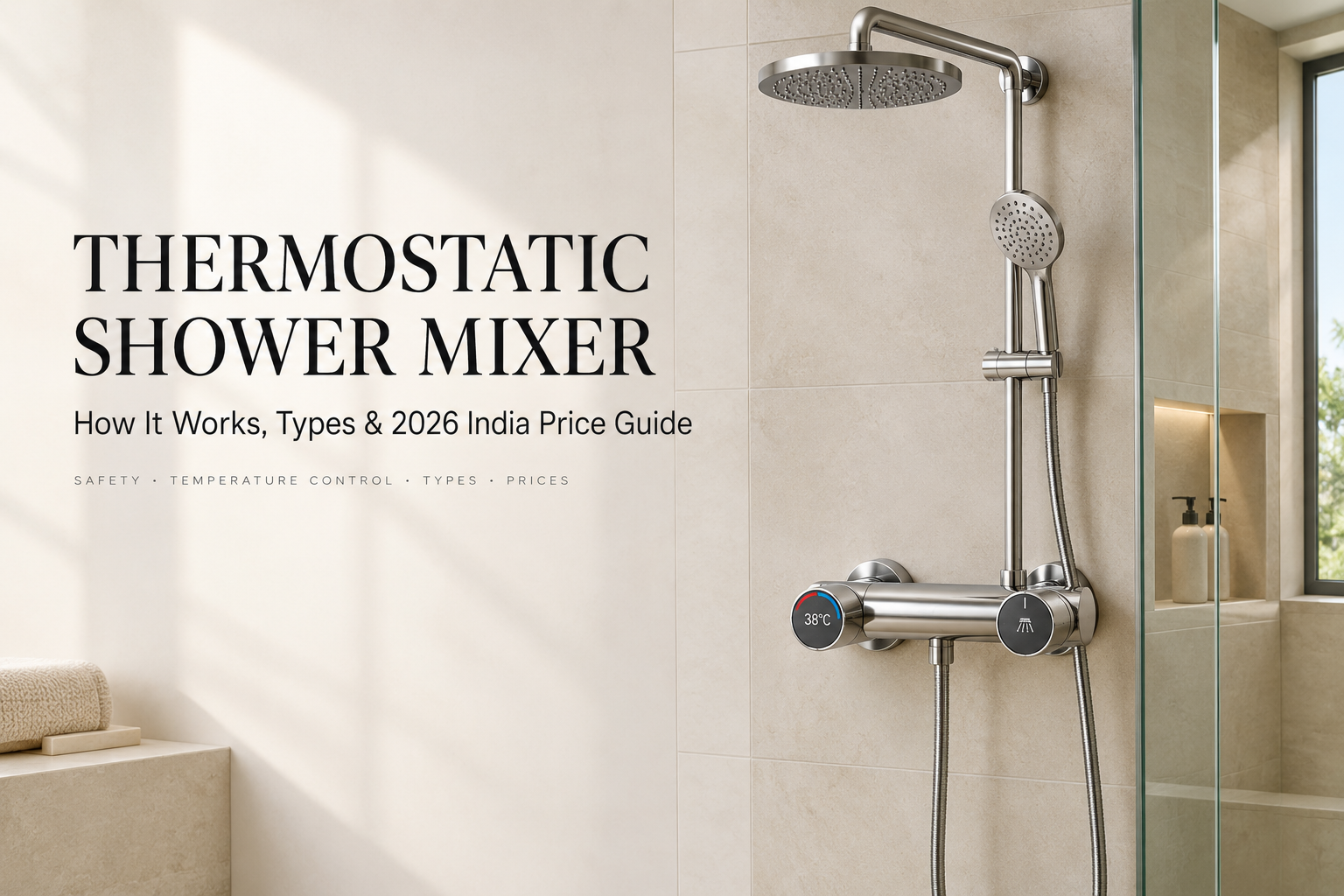
A thermostatic shower mixer locks your water at one exact temperature and holds it there, even when someone flushes a toilet on the floor above or a solar geyser suddenly runs hotter under the afternoon sun. Indian plumbing rarely delivers steady pressure or steady heat, which is exactly why this fitting has moved from a niche import to a genuine bathroom essential. This guide explains what a thermostatic shower mixer is, how its wax element or bimetallic strip reacts to temperature changes, which type suits your bathroom, what installation demands before you buy, and what a reliable unit costs in India through 2026.
What Is a Thermostatic Shower Mixer
A thermostatic shower mixer is a valve that blends hot and cold water to a temperature you set once, then holds that exact temperature no matter what happens elsewhere in the building’s plumbing. You dial in 38 degrees, walk away, and the water stays at 38 degrees.
- Set once, stays put: turn the temperature dial to your comfort level and it locks there across every use
- Anti-scald cutoff: an internal stop prevents the flow from climbing past roughly 38 to 42 degrees, even if the hot supply spikes
- Separate flow control: a second handle or lever starts and stops the water, so the temperature setting never resets when you turn the shower on or off
- Consistent output regardless of pressure shifts: a tap running elsewhere in the house barely changes what reaches your skin
Add one to your bathroom and it pairs naturally with a wider shower and bath accessories upgrade, since most premium ranges now sell the mixer alongside a matching hand shower and overhead unit.
Thermostatic Mixer vs Manual Mixer vs Pressure-Balancing Valve
Buyers often confuse three fittings that look similar on a showroom wall but behave very differently under real water pressure.
| Feature | Thermostatic Mixer | Manual Mixer | Pressure-Balancing Valve |
| Temperature control | Automatic, holds a set degree | Manual, adjusted by feel | Automatic, but only balances pressure |
| Anti-scald protection | Yes, built in cutoff | None | Partial, prevents pressure drop scalds only |
| Reacts to a flush or tap elsewhere | Barely noticeable change | Sudden hot or cold surge | Keeps ratio steady, temperature can still drift |
| Installation complexity | Needs hot and cold supply, more parts | Simple, fewer parts | Moderate |
| Typical price in India (2026) | ₹8,000 to ₹2,50,000 | ₹1,200 to ₹8,000 | ₹5,000 to ₹18,000 |
| Best for | Families, elderly members, children, premium renovations | Tight budgets, simple bathrooms | Homes with fluctuating pressure but stable geyser heat |
A pressure-balancing valve only equalises hot and cold pressure. It stops a sudden cold blast when someone opens another tap, but it will not stop the water from running scalding hot if your geyser itself overheats. Only a thermostatic mixer controls the actual temperature.
How a Thermostatic Shower Mixer Works
Inside every thermostatic shower mixer sits a small temperature sensitive element, usually a wax cartridge or a bimetallic strip. Wax expands at a predictable rate as it warms, and manufacturers calibrate that expansion to push a piston that closes off the hot water port the instant the blend reaches your set temperature.
A bimetallic strip works on the same principle with metal instead of wax. Two different metals bonded together bend at different rates as they heat, and that bending motion opens or closes the valve.
Quick fact: The cartridge inside a quality thermostatic mixer reacts to temperature swings within roughly one to two seconds, fast enough to catch a sudden hot water surge before it reaches your skin.
Neither mechanism needs electricity or batteries. The physics of expanding wax or bending metal does the entire job, which is why thermostatic mixers stay reliable through Mumbai’s frequent power cuts and voltage fluctuations.
Why It Matters More in Indian Bathrooms
Indian water supply behaves less predictably than plumbing systems in Europe or the US, and that gap is exactly where a thermostatic mixer earns its price.
- Municipal supply interruptions: cold water pressure drops suddenly when a neighbour’s tap or a building’s common pump kicks in, and a manual mixer lets that gap turn into a scalding surge
- Solar geyser spikes in summer: solar water heaters lack the tight thermostatic control of electric geysers, so tank water can climb well past 60 degrees on a hot afternoon with nobody using it
- Shared geyser across multiple outlets: homes where one geyser feeds two or three bathrooms see temperature swings the moment another outlet opens
- Hard water across Mumbai and Navi Mumbai: mineral buildup inside a cheap cartridge shortens its life, so buying a mixer rated for hard water matters as much as the brand name
Interior designers now specify thermostatic mixers as standard in premium renovations for exactly these reasons, and NRI buyers returning to Indian homes often request them to match the European bathroom standards they grew used to abroad. A stable shower temperature also supports the daily routine argument in how your bathroom can boost daily wellness, since a shower that keeps surprising you with hot or cold jolts undoes any relaxation benefit.
Surface-Mounted Bar Mixer vs Concealed Thermostatic Valve
Two formats dominate the Indian market, and your construction stage usually decides which one fits.
| Type | How it installs | Best for | Typical price (INR) |
| Surface-mounted bar mixer | Fixed to the finished wall, pipework stays exposed or in a shallow chase | Renovations, retrofits, rented flats | ₹8,000 to ₹35,000 |
| Concealed thermostatic valve | Body recessed inside the wall before tiling, only the control plate shows | New construction, full bathroom rebuilds | ₹20,000 to ₹1,50,000 |
A surface-mounted bar mixer suits homeowners upgrading an existing bathroom without opening walls. A plumber connects it to your current hot and cold lines and finishes the job in a few hours.
A concealed thermostatic valve demands planning before the tiler arrives, since the rough-in body must sit inside the wall at the correct depth. Pair it with a bathroom hand shower on a slide rail, and many homeowners add a bathroom rain shower guide recommendation from their plumber to complete a concealed three-outlet system in one go.
Installation Requirements Before You Buy
- Both hot and cold supply lines must reach the mixer point. The valve blends two inputs, so a single pipe feed from a geyser will not work.
- Minimum pressure of 0.5 to 1 bar on both lines. Low rise buildings with gravity fed tanks close to the bathroom sometimes fall short, so ask your plumber to check.
- Balanced pressure between hot and cold where possible. A large gap between the two, common when a booster pump serves only the cold line, can limit how well the cartridge blends.
- Decide the finish stage early for concealed models. The valve body goes in before tiling, so lock this into your bathroom renovation checklist well ahead of the plumber’s first visit.
- Flush both lines before final connection. Loose solder bits or sand from new pipework can jam a wax cartridge within its first month.
Budget ₹1,500 to ₹4,000 for a straightforward exposed swap and ₹8,000 to ₹20,000 for concealed installation, including any wall repair and re-tiling.
Thermostatic Shower Mixer Price Guide in India (2026)
| Category | Price range | What you get |
| Entry level exposed mixers | ₹8,000 to ₹15,000 | Basic wax cartridge, chrome finish, single outlet |
| Mid-range concealed valves | ₹18,000 to ₹40,000 | Better cartridge accuracy, two to three outlet control, brass body |
| Premium imported systems | ₹40,000 to ₹90,000 | Precision German or Italian cartridges, PVD finishes, longer warranty |
| Luxury and digital models | ₹90,000 to ₹2,50,000 | Digital display, programmable presets, multi-outlet body jets |
Follow a simple bathroom fittings maintenance routine once you install one, since descaling the cartridge every six to twelve months in hard water areas keeps the temperature lock accurate for years instead of months.
A Steadier, Safer Shower Starts With the Right Mixer
A thermostatic shower mixer trades a small upfront cost for years of consistent, scald-free showers, something Indian plumbing rarely delivers on its own. Match the type to your construction stage, confirm your pipework can supply both hot and cold lines at proper pressure, and choose a cartridge built for hard water. Explore imported thermostatic mixers and complete shower systems at Salus India, where 50 years of expertise stand behind every fitting.
Frequently Asked Questions
Q1. What is a thermostatic shower mixer?
It is a shower valve that blends hot and cold water to a temperature you set once and then holds that exact temperature automatically. A wax cartridge or bimetallic strip inside reacts to heat changes and adjusts the internal ports within a second or two. Unlike a manual mixer, you never need to rebalance the handles mid-shower.
Q2. How is a thermostatic mixer different from a manual mixer?
A manual mixer needs you to balance two handles by feel every time, and any pressure change elsewhere in the building throws that balance off instantly. A thermostatic mixer holds the set temperature on its own and includes a built in cutoff near 38 to 42 degrees, so a sudden hot surge never reaches your skin.
Q3. Can a thermostatic shower mixer prevent scalding from a solar geyser?
Yes. Solar geysers often heat water well past comfortable levels on sunny afternoons since they lack the tight thermostat control of electric units. A thermostatic mixer blends that overheated supply down to your set temperature automatically, and its anti-scald stop blocks water from crossing a safe limit even during a summer spike.
Q4. Does a thermostatic mixer work when one geyser feeds multiple bathrooms?
It works well in exactly this situation. Shared geyser setups see temperature and pressure swings whenever another outlet opens, and a thermostatic mixer’s cartridge corrects for that within seconds. A basic manual mixer offers no such correction, so shared geyser homes benefit the most from upgrading.
Q5. What water pressure does a thermostatic shower mixer need?
Most models need at least 0.5 to 1 bar on both the hot and cold lines to blend accurately. Top floor flats on gravity fed tanks sometimes fall below this, which weakens the mixer’s response time. A small booster pump, usually under ₹15,000 installed, solves the problem for most Indian apartments.
Q6. How much does a good thermostatic shower mixer cost in India?
Reliable exposed models start around ₹8,000 to ₹15,000, while concealed valves with better cartridges run ₹18,000 to ₹40,000. Premium imported systems with precision cartridges cross ₹40,000, and digital or multi-outlet luxury units can reach ₹2,50,000. Installation adds ₹1,500 to ₹20,000 depending on exposed or concealed work.
Q7. Do thermostatic mixers need extra maintenance in hard water areas?
Yes, more than a basic tap. Mineral deposits from hard water, common across Mumbai and Navi Mumbai, can coat the wax cartridge and slow its reaction time. Descaling the valve every six to twelve months and choosing a mixer rated for hard water keeps the temperature lock accurate for years.