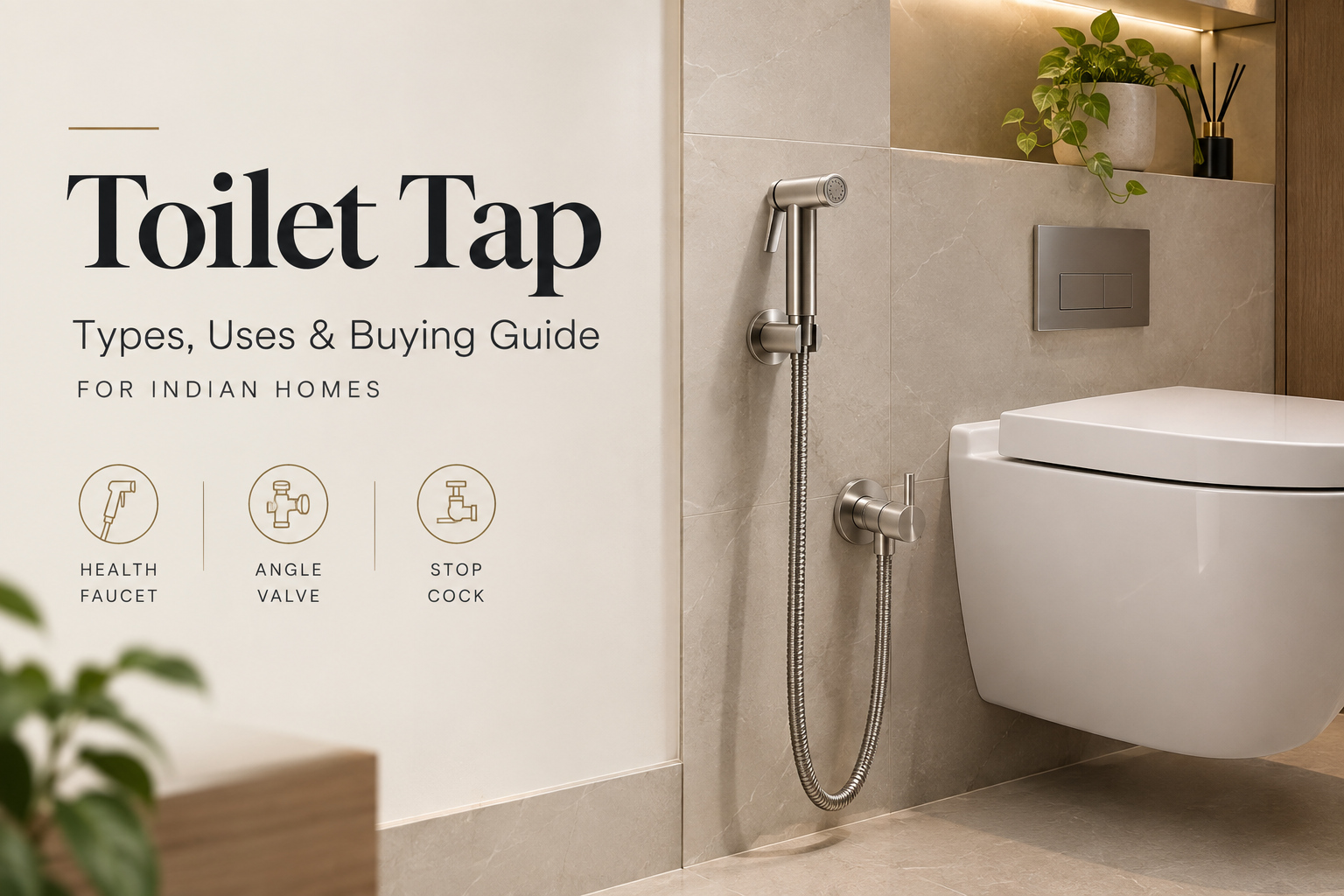
Toilet Tap: Types, Uses & Buying Guide for Indian Homes
Three taps sit within arm’s reach of every Indian toilet, and most homeowners can name only one of them.
Ask for a toilet tap in a Mumbai hardware market and you could walk out with a health faucet, an angle valve, or a stop cock. All three share the name and do very different jobs. This guide explains each type, how to pick fittings that survive Indian water, and what they cost in 2026.
Table of Contents
- What Is a Toilet Tap?
- Types of Toilet Taps in Indian Bathrooms
- Choosing the Right Health Faucet
- Angle Valves and Stop Cocks: The Taps Behind the Wall
- Installation Tips for Indian Plumbing
- Toilet Tap Price Range in India (2026)
- Frequently Asked Questions
What Is a Toilet Tap?
A toilet tap is any tap fitted in the toilet zone of a bathroom. In Indian homes the term covers two things: the health faucet, the handheld spray used for personal hygiene, and the supply valves, the angle valve and stop cock, that control water flowing to the cistern and the spray.
Three fittings share the name in India:
- Health faucet: A handheld spray on a flexible hose, also sold as a jet spray or bidet spray.
- Angle valve: A small quarter-turn valve that feeds one outlet, usually the cistern or the health faucet, and shuts it off independently.
- Stop cock: A heavier valve on the main line that controls supply to the entire bathroom.
All three belong to the same family as your other bathroom taps and faucets, and the same rules on material and thread size apply.
Quick fact: A health faucet uses roughly 1 to 1.5 litres of water per use. Producing a single roll of toilet paper consumes an estimated 140 litres. That makes the toilet tap one of the most water-efficient hygiene fittings in the world.
Types of Toilet Taps in Indian Bathrooms
Each fitting in the toilet zone has one specific job. Buy by function, not by name.
| Fitting | Job It Does | Typical Position |
| Health faucet (jet spray) | Personal hygiene, rinsing the pan, quick floor cleaning | Wall hook beside the toilet |
| Single angle valve | Controls water to one outlet: cistern, faucet, or basin | Beside or below the cistern inlet |
| Two-way angle valve | Feeds cistern plus health faucet from one inlet | Below the cistern |
| Stop cock | Shuts the full bathroom line for repairs | On the main line, often concealed |
| Bib cock (utility tap) | Bucket filling and washing near the toilet | Lower wall in the washing zone |
Count outlets before you buy. A standard toilet zone needs one valve for the cistern, one for the health faucet, and a stop cock on the line. A two-way valve covers the first two and saves one hole through the tile.
Buy every visible fitting in the same finish. Mixed finishes age at different rates, and it shows within a year.
Choosing the Right Health Faucet
The health faucet is the toilet tap your family touches every day, so quality matters most here.
Body Material
- ABS plastic with chrome coat: Light, rust-proof, and cheap. Fine for rentals and guest toilets, but the trigger wears out in 2 to 3 years.
- Brass with chrome plating: The workhorse. It handles pressure fluctuation and accidental drops, and lasts 8 to 10 years.
- Stainless steel (SS 304): Rust-proof and sturdy, with a brushed look that hides water spots well.
- Designer finishes: Matte black, gunmetal, and brushed gold, matched to the basin mixer in premium Mumbai and Navi Mumbai projects.
Nozzle Design and Hard Water
Water across Mumbai, Navi Mumbai, and most Indian cities runs hard, and scale blocks fixed metal spray grills within months. Choose silicone anti-limescale nozzles: a thumb rub releases the calcium, no chemicals needed.
Match the faucet finish with your shower and bath accessories so the toilet zone reads as part of one designed bathroom. Comfort here shapes your morning more than most people admit; read how your bathroom can boost daily wellness for the wider view.
Angle Valves and Stop Cocks: The Taps Behind the Wall
An angle valve works silently for years, so nobody thinks about it until water weeps down the wall. Older spindle valves press a rubber washer shut, and that washer hardens and fails. Modern quarter-turn valves use a ceramic disc cartridge and outlast rubber by years.
Replace an angle valve when:
- Water seeps around the spindle even in the closed position
- The handle needs force instead of a smooth quarter turn
- Flow to the cistern drops, a sign of scale inside the valve body
The same valves feed your wash basin range, so carry the same standard through the bathroom. Swapping valves costs the least during renovation, while walls are open, so add a full valve count to your bathroom renovation guide before the plumber closes the tiling.
Installation Tips for Indian Plumbing
Indian bathrooms run on 1/2 inch BSP threads, and nearly every fitting sold here matches that standard. The sequence below covers a health faucet or angle valve swap.
- Close the stop cock and open a tap to drain pressure from the line.
- Confirm the new fitting is 1/2 inch BSP. A few European imports use metric threads and need an adaptor.
- Wrap Teflon tape 6 to 8 turns clockwise around the male thread.
- Hand-tighten first, then finish with a half turn of the spanner. Brass cracks when overtightened.
- Mount the health faucet hook 60 to 75 cm above the floor, within easy reach from the seat.
- Open the stop cock fully and check every joint at peak pressure.
Pro tip: Give the health faucet its own angle valve instead of a T-joint off the cistern line. You can then shut the spray line at night or when travelling. Burst hoses cause most toilet flooding in Indian flats.
Toilet Tap Price Range in India (2026)
Prices reflect the Indian market in 2026 across hardware stores, showrooms, and online listings.
| Fitting | Price Range (INR) | What You Get |
| ABS health faucet set | 300 to 900 | Plastic body, PVC hose, basic wall hook |
| Brass / SS health faucet set | 900 to 3,500 | Metal body, braided SS hose, anti-limescale nozzles |
| Designer or imported health faucet | 3,500 to 9,000 | Matte black or gold finishes, slim profiles, premium hoses |
| Brass angle valve (quarter turn) | 350 to 1,500 | Ceramic disc cartridge, chrome finish |
| Two-way angle valve | 600 to 2,500 | One inlet, two outlets, saves a wall point |
| Stop cock | 400 to 2,200 | Heavy brass body, full-line control |
Check whether a listed price covers the full set or the spray head alone. Marketplace listings often sell the handset without hose and hook. Plumber charges in Mumbai add INR 150 to 500 per fitting.
Budget for upkeep too. Descale the spray twice a year and replace hoses every 3 to 4 years. A simple bathroom fittings maintenance routine doubles the working life of every fitting on this page.
Frequently Asked Questions
Q1. What is a toilet tap called in India?
Hardware shops use three names for taps in the toilet zone. The handheld spray is a health faucet, jet spray, or bidet spray. The small wall valve feeding the cistern is an angle valve or angle cock. The heavier valve controlling the whole line is a stop cock. Quote the exact fitting name when buying to avoid the wrong part.
Q2. What is the difference between an angle valve and a stop cock?
An angle valve controls water to a single outlet, such as the cistern, health faucet, or basin tap, and turns the flow through a 90 degree bend. A stop cock sits on the main supply line and shuts off the entire bathroom. Think of angle valves as switches for individual fittings and the stop cock as the mains switch.
Q3. Which health faucet works best in hard water areas like Mumbai?
Choose a health faucet with silicone anti-limescale nozzles and a brass or stainless steel body. Silicone nozzles release calcium deposits with a finger rub, no chemicals needed. Avoid cheap sprays with fixed metal grills, because scale blocks them within months in hard water. A monthly wipe and a vinegar soak twice a year keep the spray pattern even.
Q4. What size thread does a toilet tap use in India?
Indian plumbing uses 1/2 inch BSP threads for health faucets, angle valves, and stop cocks. Almost every fitting sold in India matches this standard. Check before buying European fittings, since a few use metric threads and need an adaptor, which adds one more potential leak point.
Q5. Why does my health faucet drip after use?
A slow drip usually means a worn washer or cartridge inside the spray trigger, not a hose fault. Constant dripping from the hose joint points to a loose connection or a failed Teflon seal. Replace the trigger cartridge or re-tape the joint. If the drip continues, shut the dedicated angle valve until a plumber replaces the head.
Q6. Can I install a toilet tap myself?
Replacing a health faucet on an existing angle valve is a 15 minute job: shut the valve, unscrew the old hose, tape the threads, and fit the new set. Replacing an angle valve or stop cock needs the main supply shut and careful thread work, so call a plumber. A cracked thread inside a tiled wall costs far more than the visit.
Q7. How much does a toilet tap cost in India in 2026?
Budget ABS health faucet sets cost INR 300 to 900. Brass and stainless steel sets with braided hoses run INR 900 to 3,500, and designer or imported models reach INR 9,000. Angle valves cost INR 350 to 1,500, two-way valves INR 600 to 2,500, and stop cocks INR 400 to 2,200.
Q8. Is a brass health faucet better than a plastic one?
For daily family use, yes. Brass bodies handle pressure fluctuation, accidental drops, and constant bathroom humidity far better than ABS plastic, and they last 8 to 10 years against 2 to 3 for budget plastic sets. ABS still makes sense for rental flats and low-use guest toilets, where replacement cost matters more than lifespan.
Small Taps, Long Service
A well-chosen toilet tap disappears into daily life: the spray works, the valves hold, and you never give them a thought. That reliability comes from brass bodies, ceramic cartridges, and correct 1/2 inch BSP installation, not from luck.
Explore Salus India’s range of health faucets, angle valves, and bathroom fittings: imported designs in chrome, matte black, and brushed finishes, at our Navi Mumbai showroom and online at salusindia.com.