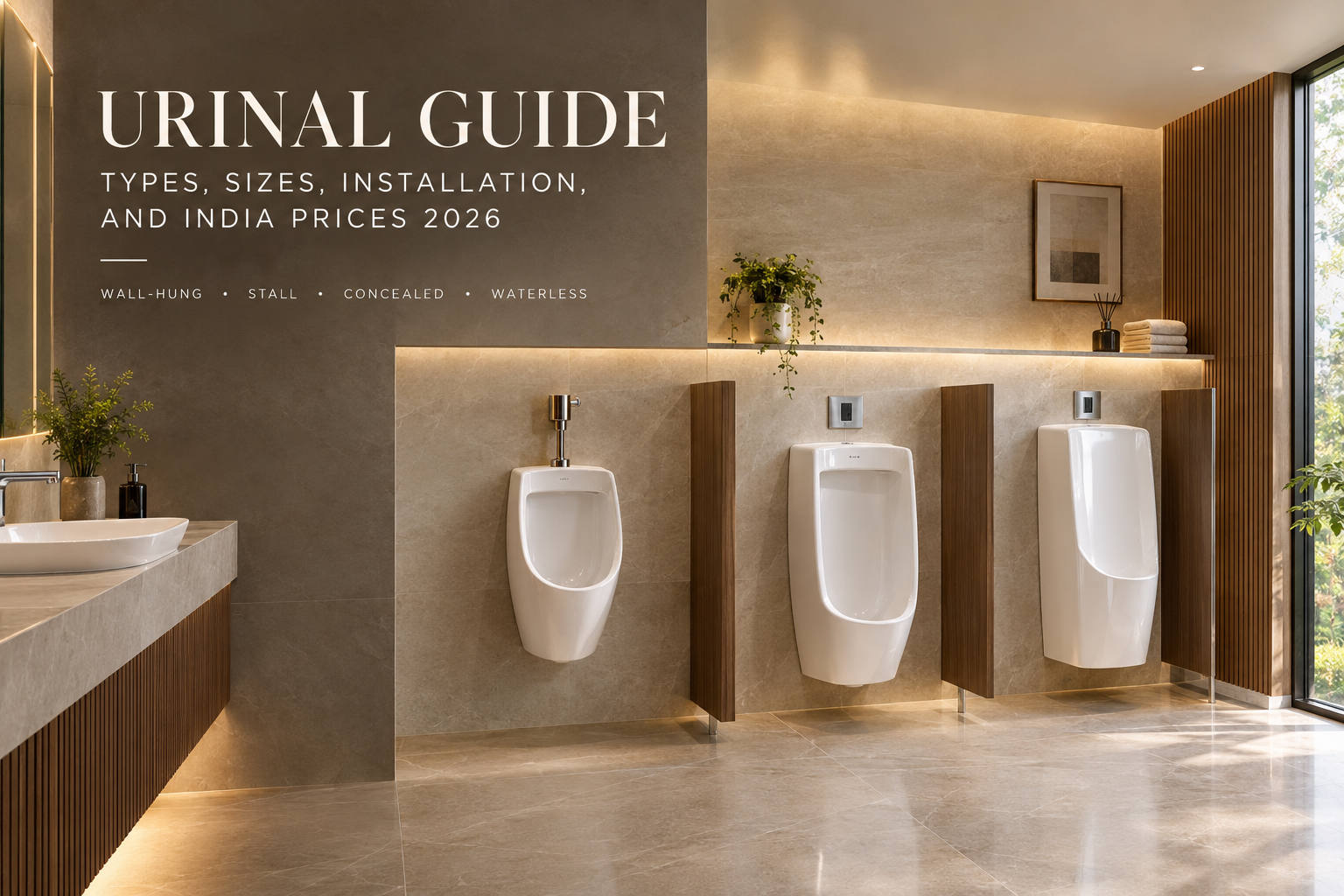
A urinal saves water, reduces toilet cleaning frequency, and uses less floor space than a standard WC for the task it handles. In Indian residential bathrooms with two or more male users, a urinal alongside a WC can cut toilet use by 30 to 40 percent for that user group, which directly reduces the cleaning burden and the seat-left-up friction that every household knows. In commercial bathrooms (offices, restaurants, gyms), a urinal is standard. This guide covers how urinals work, the types available in India, what to check before installation, and what a quality urinal costs in 2026.
What Is a Urinal?
A urinal is a wall-hung sanitary fitting designed for male use only, connected to a cold water flush supply and the soil pipe. It consists of a ceramic bowl that collects and channels waste to the trap and soil connection below, a flush inlet at the top or side, and a trap and outlet connection at the base or rear of the bowl.
Browse Salus India’s bathroom accessories and sanitary range alongside the full bathroom fitting range for residential and commercial Indian bathrooms.
Types of Urinals
Standard Wall-Hung Urinal
The most common type in Indian bathrooms and commercial premises. The bowl mounts to the wall with a concealed bracket or wall-hung fixings. The waste pipe connects through or below the wall. Available in single units and in series for commercial installations. Requires a wall supply connection for flush and a soil pipe at the correct height behind or below the wall.
Stall Urinal
A larger format urinal with extended side wings and a longer bowl depth, designed for higher-traffic commercial bathrooms. Provides more coverage and is less likely to splash. Typically found in airports, hotels, and large office buildings. Less common in Indian residential use due to size.
Concealed Cistern Urinal (Auto-Flush)
A wall-hung urinal with a concealed flush cistern built into a duct or cavity behind the wall. An auto-flush mechanism (sensor-triggered or timed interval) operates the flush without a visible manual handle. Required in commercial bathrooms under National Building Code guidelines for public sanitary facilities. Cleaner appearance and hands-free operation; higher installation cost due to duct work.
Waterless Urinal
A urinal with no flush connection, using a liquid sealant trap or a cartridge insert to contain odour without water. Saves approximately 40,000 to 150,000 litres of water per unit per year. Requires the sealant cartridge to be replaced every 3 to 7 months depending on use. Gaining adoption in Indian green building projects and LEED-rated buildings. Not yet common in Indian residential bathrooms.
Urinal Sizes and Heights
Standard Indian urinal dimensions:
| Dimension | Standard Range |
| Bowl width | 300 to 380 mm |
| Bowl depth (projection) | 280 to 350 mm |
| Bowl height (total) | 550 to 650 mm |
| Mounting height (rim from floor) | 550 to 600 mm for adults; 350 to 400 mm for children |
For residential bathrooms, a standard adult-height wall-hung urinal with a 330 to 380 mm width suits most Indian bathroom layouts. For a children’s or accessible urinal, the rim height drops to 350 to 400 mm.
The minimum floor space in front of a urinal should be 600 mm clear for comfortable use and 750 mm for accessible compliance under Indian Standard IS 3442.
Flush Volume and Water Efficiency
Indian urinals typically flush at 1.5 to 2 litres per flush. Older models flush at 4 to 6 litres per flush. When specifying a urinal for a new installation, choose a 1.5-litre flush model. This is the standard in BIS-certified urinals and complies with the BEE water efficiency ratings that apply to commercial projects.
A sensor-activated flush system on a commercial urinal eliminates the water waste of timed interval flushing, where the cistern flushes whether the urinal was used or not.
Installation Requirements
A urinal requires:
- A cold water supply connection (BSP 1/2 inch inlet, standard in India)
- A soil pipe connection at the correct height and position behind or below the wall
- A wall capable of taking the fixing load: a solid masonry or concrete wall for a standard urinal; a steel-framed duct if using a concealed cistern system
- Adequate floor-to-ceiling height for the flush cistern if it is surface-mounted above the urinal
The soil pipe must connect at or below the outlet of the urinal trap without requiring an upward run of waste pipe. An upward waste run from a urinal will not drain by gravity. Check your bathroom renovation planning checklist before the rough-in phase if adding a urinal to a residential bathroom, as the soil pipe position determines whether the installation is feasible.
Maintenance
Flush the urinal after every use in residential settings. In Mumbai’s hard water, uric scale and limescale accumulate at the trap outlet and at the flush inlet nozzle within weeks. Descale monthly with a proprietary urinal descaler or a diluted white vinegar solution. A consistent bathroom fittings maintenance routine keeps the trap clear and the bowl surface hygienic. A clean, odour-free bathroom is a direct product of fitting quality and maintenance frequency, as this piece on daily bathroom wellness discusses.
Urinal Price Guide India 2026
| Type | Size | Price (INR) |
| Standard wall-hung, manual flush | 330-380 mm | ₹3,000 to ₹8,000 |
| ISI-marked wall-hung | 330-380 mm | ₹5,000 to ₹12,000 |
| Stall urinal | 500+ mm | ₹8,000 to ₹20,000 |
| Concealed cistern auto-flush set | 330-380 mm | ₹15,000 to ₹40,000 |
| Waterless urinal | 330-380 mm | ₹8,000 to ₹25,000 |
Installation: ₹3,000 to ₹8,000 for a standard wall-hung unit with existing soil pipe connection. New soil pipe and supply connection: ₹8,000 to ₹20,000 additional.
Conclusion
A urinal is a practical addition to any Indian residential bathroom with two or more male users. Specify a 1.5-litre flush model, confirm the soil pipe position before purchase, and mount the rim at 550 to 600 mm for adults. For commercial bathrooms, a sensor-flush concealed cistern system eliminates maintenance of timed-interval flushing. Salus India’s sanitary range includes wall-hung urinals in standard residential sizes for Indian building installations.
Frequently Asked Questions
Q1. What is the standard mounting height for a urinal in India?
The rim of an adult urinal should be 550 to 600 mm from the finished floor level. For a children’s urinal, reduce this to 350 to 400 mm. For accessible urinals under IS 3442, the rim should be no higher than 430 mm from finished floor. The clear floor space in front of the urinal should be at least 600 mm, or 750 mm for an accessible installation.
Q2. Does a urinal need a separate soil pipe, or can it share the WC soil pipe?
A urinal can connect to the same soil stack as the WC if the stack is sized correctly and the urinal outlet connects at or above the WC connection point. However, the urinal must have its own trap and a dedicated branch connection to the stack. Do not connect the urinal waste directly to the WC pan outlet; this creates a shared trap that will allow cross-contamination of odours between fittings.
Q3. Why does my urinal smell even after flushing?
A persistent smell after flushing usually means uric scale has built up in the trap, creating a surface where bacteria grow and produce odour. Descale the trap monthly with a proprietary urinal descaler or a white vinegar soak. In hard water cities like Mumbai, uric scale bonds to limescale quickly. If the smell persists after descaling, the trap may be partially blocked; remove and clean the trap insert or replace it.
Q4. How much water does a urinal use per flush in India?
Modern BIS-certified urinals flush at 1.5 to 2 litres per flush. Older Indian models flush at 4 to 6 litres. A sensor-activated system flushes only when the urinal is used, saving water compared to a timed-interval cistern that flushes every 10 to 15 minutes regardless of use. Waterless urinals use zero flush water, saving 40,000 to 150,000 litres per unit per year.
Q5. Can I install a urinal in a residential bathroom in India?
Yes. There is no building code restriction against a residential urinal in India. The practical requirements are a cold water supply point, a soil pipe connection at the correct height, and a solid wall to fix the bracket. A residential wall-hung urinal in standard 330 to 380 mm width fits in bathrooms as small as 1,500 x 1,500 mm if positioned on a separate wall from the WC.
Q6. What is the difference between an ISI-marked urinal and an unbranded urinal?
An ISI mark on a urinal (IS 2556 standard, vitreous china sanitary ware) confirms that the ceramic body, glaze finish, water absorption, and dimensional tolerances have been tested against the Indian Standard. Unbranded urinals use thinner vitreous china with unverified glaze quality, which leads to surface crazing, staining, and odour retention over time. For residential or commercial use, always choose ISI-marked sanitary ware.
Q7. How often should I descale a urinal in a hard water area?
Descale a residential urinal monthly in Mumbai’s hard water. For high-use commercial urinals, descale weekly. Use a proprietary urinal descaler or diluted white vinegar (1:3 with water), pour it into the bowl and trap, leave for 20 to 30 minutes, then flush thoroughly. Monthly descaling prevents uric scale and limescale from bonding into hard deposits that require mechanical removal.