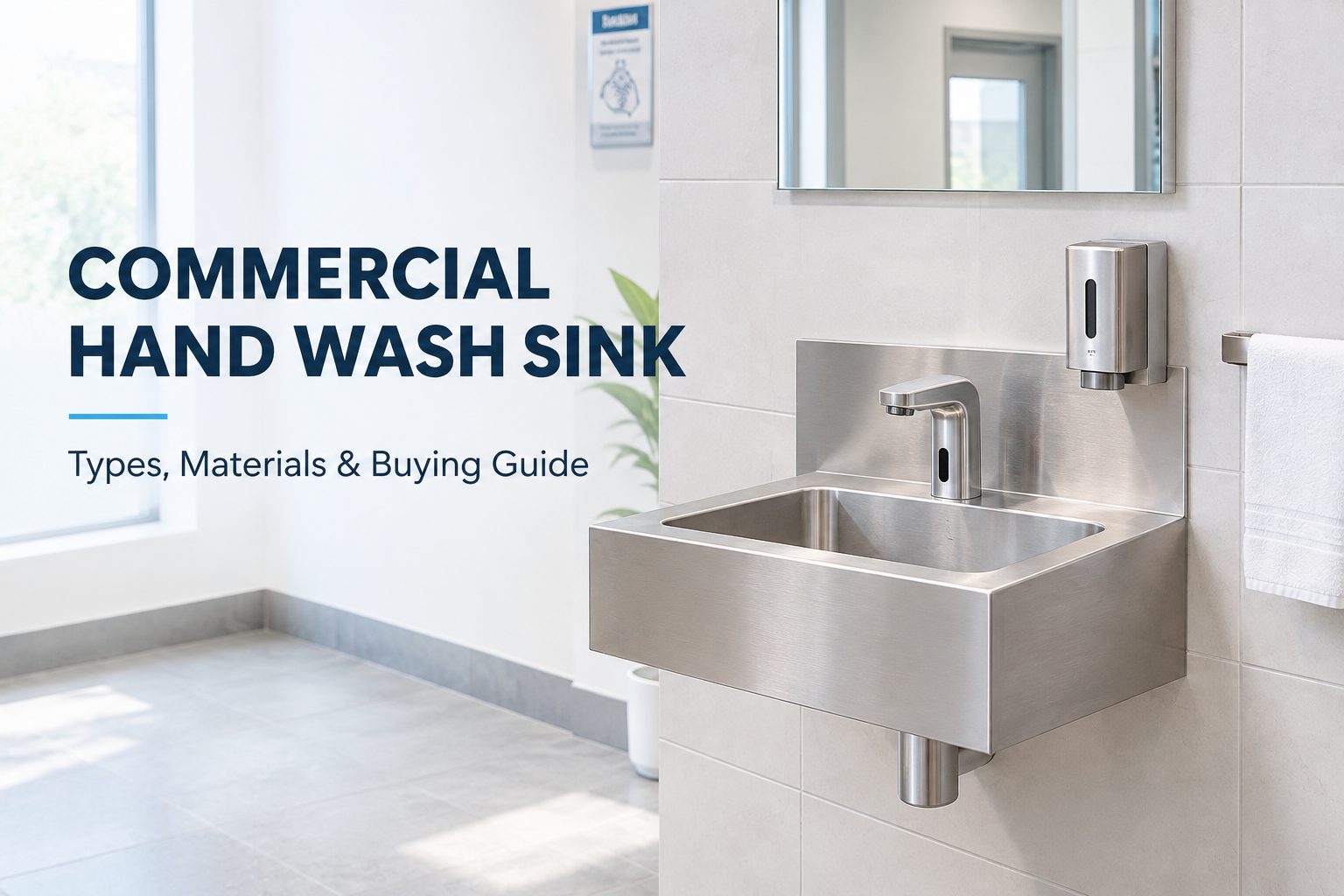
Hygiene inspections rarely begin in the kitchen. They begin at the wash station.
A commercial hand wash sink handles what a home basin never faces: hundreds of uses a day, harsh cleaning chemicals, and audit checklists from FSSAI officers and hospital accreditation teams. Offices, restaurants, hospitals, and schools each need a different type. This guide compares stainless steel, ceramic, and trough models, explains India’s compliance rules, and gives realistic price ranges in INR.
Table of Contents
- What Is a Commercial Hand Wash Sink?
- Types of Commercial Hand Wash Sinks
- Which Material Survives Indian Conditions?
- Hygiene Compliance in Indian Commercial Spaces
- Installation: Plan These Five Things First
- Price Range in India (INR)
- Frequently Asked Questions
What Is a Commercial Hand Wash Sink?
A commercial hand wash sink is a dedicated fixture used only for washing hands, kept separate from utensil, mop, and food preparation sinks. That separation prevents cross-contamination and gives staff a wash point they never queue for.
Build quality separates it from a household basin. Commercial units use thicker material, faster-draining wastes, and taps rated for thousands of cycles a month, and many skip hand-operated taps for sensor, knee, or foot controls.
Quick fact: FSSAI’s Schedule 4 hygiene conditions make a separate hand washing facility with soap mandatory for licensed food businesses in India. A shared utensil sink does not qualify during inspection.
Front-of-house areas play by different rules. There the sink carries the brand impression, so designers often specify pieces from a premium wash basin collection rather than bare steel.
Types of Commercial Hand Wash Sinks
Match the type to the traffic, not the catalogue photo. Six formats cover almost every Indian commercial space.
| Type | Built For | Users at Once | Typical Spec |
| Wall mounted ceramic basin | Offices, clinics, guest washrooms | 1 | Vitreous china, 45 to 60 cm wide |
| Stainless steel wash station | Restaurant and cloud kitchens | 1 | SS 304 with integrated splashback |
| Countertop or semi-recessed basin | Corporate washrooms, hotels | 1 | Ceramic or solid surface on vanity |
| Trough / multi-user sink | Schools, factories, hospital wards | 2 to 6 | SS 304 or solid surface, 120 to 300 cm |
| Hands-free station | Hospitals, labs, food processing | 1 to 2 | Sensor, knee, or foot-operated valve |
| Corner hand wash sink | Compact kitchens, tight corners | 1 | SS 304, roughly 40 x 40 cm |
Two patterns repeat across real projects. Kitchens and factories go stainless because it shrugs off impact, heat, and aggressive cleaning. Customer-facing washrooms go ceramic or solid surface because guests judge what they see.
For schools and factories, one 180 cm trough with three taps costs less than three separate basins with three traps and three rounds of plumbing labour.
Which Material Survives Indian Conditions?
Material choice decides how the sink looks in year five, not year one. Heat, cleaning acids, and hard water do the sorting.
| Material | What to Ask For | Hard Water Behaviour | Where It Belongs |
| Stainless steel | SS 304 grade, 0.8 to 1.2 mm thick | Spots show, wipe off fast, no etching | Kitchens, hospitals, factories |
| Ceramic / vitreous china | ISI-marked vitreous china | Glaze resists stains, scale hides on gloss white | Guest washrooms, offices, schools |
| Solid surface / quartz | Non-porous sheet, seamless joints | Matte texture masks mineral marks | Premium offices, hotels, showrooms |
| SS 202 | Avoid for wet areas | Pits and rust-streaks within a few years | Dry utility zones only |
Insist on SS 304 in writing. Suppliers quote “stainless steel” loosely, and SS 202 looks identical on delivery day but corrodes near constant moisture.
Hard water raises the stakes across Maharashtra. Commercial buildings in Mumbai and Navi Mumbai often alternate between municipal and tanker supply, and tanker water carries a heavier mineral load that settles on taps and sinks within weeks. Brushed steel and matte solid surface hide the scale; polished chrome and dark gloss ceramic broadcast it. Whatever you install, a scheduled bathroom fittings maintenance routine with regular descaling keeps the station working years past its warranty.
Hygiene Compliance in Indian Commercial Spaces
Each space type answers to a different rulebook.
- Restaurants and cloud kitchens: FSSAI Schedule 4 requires a separate hand washing facility with soap near food handling areas, and hygiene rating audits photograph it.
- Offices and factories: Section 42 of the Factories Act, 1948 mandates adequate, accessible washing facilities, with Maharashtra Factories Rules detailing numbers and placement.
- Hospitals and clinics: NABH accreditation expects hand hygiene stations near points of care, with elbow or sensor taps preferred over twist handles.
- Schools: Swachh Vidyalaya guidelines call for group handwashing units with soap, so multi-tap trough sinks are the standard fit.
Hands-free operation satisfies the most auditors at once. Sensor and elbow-operated commercial faucets and taps remove the dirtiest touchpoint in the room: the tap handle itself.
Complete the station, not just the sink. Auditors also look for soap dispensers, towel rails, and a bin, all covered by a standard bathroom accessories range. The same thinking pays off at home; this piece on how your bathroom can boost daily wellness extends the logic beyond the workplace.
Installation: Plan These Five Things First
A commercial sink installation fails at the planning stage, not the plumbing stage. Work through this sequence with your contractor.
- Fix the height. 80 to 85 cm from finished floor to rim for adults, 65 to 70 cm for primary schools, and clear knee space below for accessible stations.
- Size the drainage. High-frequency sinks need a 40 mm waste with a bottle trap, and a trough needs a slope toward its outlet.
- Lock the tap type before rough-in. Sensor taps need a concealed power point or an accessible battery panel.
- Add a splashback. Fit at least 300 mm of tile, steel, or solid surface behind the sink to protect paint and plaster.
- Slot it into the fit-out schedule. Sinks go in after tiling and before final electrical fit-off; a proper renovation planning guide shows where each trade lands.
Pro tip: Send the sink’s technical drawing to your plumber before tiling begins. Rough-in points set even 5 cm off-spec force ugly extension pieces later, and reworking concealed plumbing after tiling costs three to four times the original job.
Price Range in India (INR)
Prices below reflect the 2026 market across Mumbai, Navi Mumbai, and most metro suppliers. Imported and designer ranges sit in the upper bands.
| Category | Price Range (INR) | What You Get |
| Wall mounted ceramic basin | 2,000 to 8,000 | ISI vitreous china, standard shapes |
| SS 304 single wash station | 4,500 to 15,000 | Splashback, wall bracket, kitchen-grade build |
| Sensor / hands-free station | 12,000 to 35,000 | SS 304 body, sensor or pedal valve |
| Trough / multi-user sink | 15,000 to 60,000 | 2 to 6 tap points, school and factory formats |
| Designer / solid surface | 25,000 to 80,000+ | Imported ranges, seamless premium finishes |
Budget beyond the sink itself. Taps, waste coupling, and bottle trap add 1,500 to 10,000 INR per station, and standard installation runs 800 to 3,500 INR per unit. Sensor stations add wiring costs.
One honest rule: never pair a premium sink with the cheapest tap on the shelf. The tap absorbs the daily abuse and always fails first.
Frequently Asked Questions
Q1. What is the difference between a commercial hand wash sink and a regular wash basin?
A commercial hand wash sink is built for high-frequency use: thicker material, faster drainage, tougher taps, and often hands-free operation. It stays dedicated to handwashing, separate from utensil or utility sinks. A home basin handles a fraction of that load and rarely satisfies food safety or hospital audits.
Q2. Which material works best for a restaurant kitchen?
SS 304 stainless steel at 0.8 to 1.2 mm thickness. It handles heat, impact, and aggressive daily cleaning without chipping, and food safety auditors treat it as the default standard. Ceramic suits guest-facing washrooms but chips in kitchens. Confirm the 304 grade in writing, because SS 202 corrodes far sooner.
Q3. Is a separate hand wash sink mandatory for food businesses in India?
Yes. FSSAI’s Schedule 4 hygiene requirements direct licensed food businesses to provide separate hand washing facilities with soap near food handling areas. A shared utensil or mop sink fails the requirement during inspection. Hygiene rating audits photograph the wash station, so treat it as core kitchen equipment.
Q4. What size trough sink does a school need?
Work from tap points, not length alone. A 120 cm trough carries two to three taps and a 180 cm unit carries three to four. Plan enough taps for a class to wash within a short break, and set the rim at 65 to 70 cm for primary students. Swachh Vidyalaya guidelines favour these group units.
Q5. Do sensor taps work with hard water?
Yes, but they need maintenance discipline. Hard water scale blocks aerators and solenoid valves faster than it affects manual taps, so clean aerators monthly and descale quarterly wherever tanker supply is common. Choose models with accessible filters. The hygiene benefit of touch-free operation outweighs the upkeep in hospitals and kitchens.
Q6. How much does a commercial hand wash sink cost in India?
Wall mounted ceramic basins start around INR 2,000 to 8,000. SS 304 single stations run 4,500 to 15,000, sensor-operated stations 12,000 to 35,000, and multi-user trough sinks 15,000 to 60,000. Add 1,500 to 10,000 for taps and waste fittings, plus 800 to 3,500 per unit for installation.
Q7. What is the correct installation height for a commercial wash sink?
Set the rim 80 to 85 cm above finished floor level for adults, which suits offices, restaurants, and hospitals. Primary school sinks drop to 65 to 70 cm. Accessible stations need clear knee space plus lever or sensor taps. Confirm heights before rough-in, because moving supply points after tiling is expensive.
Q8. How do I stop a stainless steel sink from spotting and dulling?
Wipe it dry once a day and clean along the grain with mild soap rather than acidic descalers or steel wool. Once a week, lift mineral film with diluted vinegar, rinse, and dry. Never leave chlorine-based cleaners on the surface, since they pit steel. This routine keeps an SS 304 sink presentable for a decade.
Buy a Sink That Passes Every Audit
The right commercial hand wash sink matches your traffic, your rulebook, and your water supply, in that order. Get those three right and the fixture disappears into daily operations, exactly as it should.
Before you place the order, confirm:
- Material grade in writing (SS 304 or ISI vitreous china)
- Tap operation type your auditor expects
- Total cost including tap, trap, and installation
Specify with confidence: explore Salus India’s imported commercial and designer sanitary ranges at salusindia.com, or visit the Navi Mumbai showroom for material samples and technical drawings.