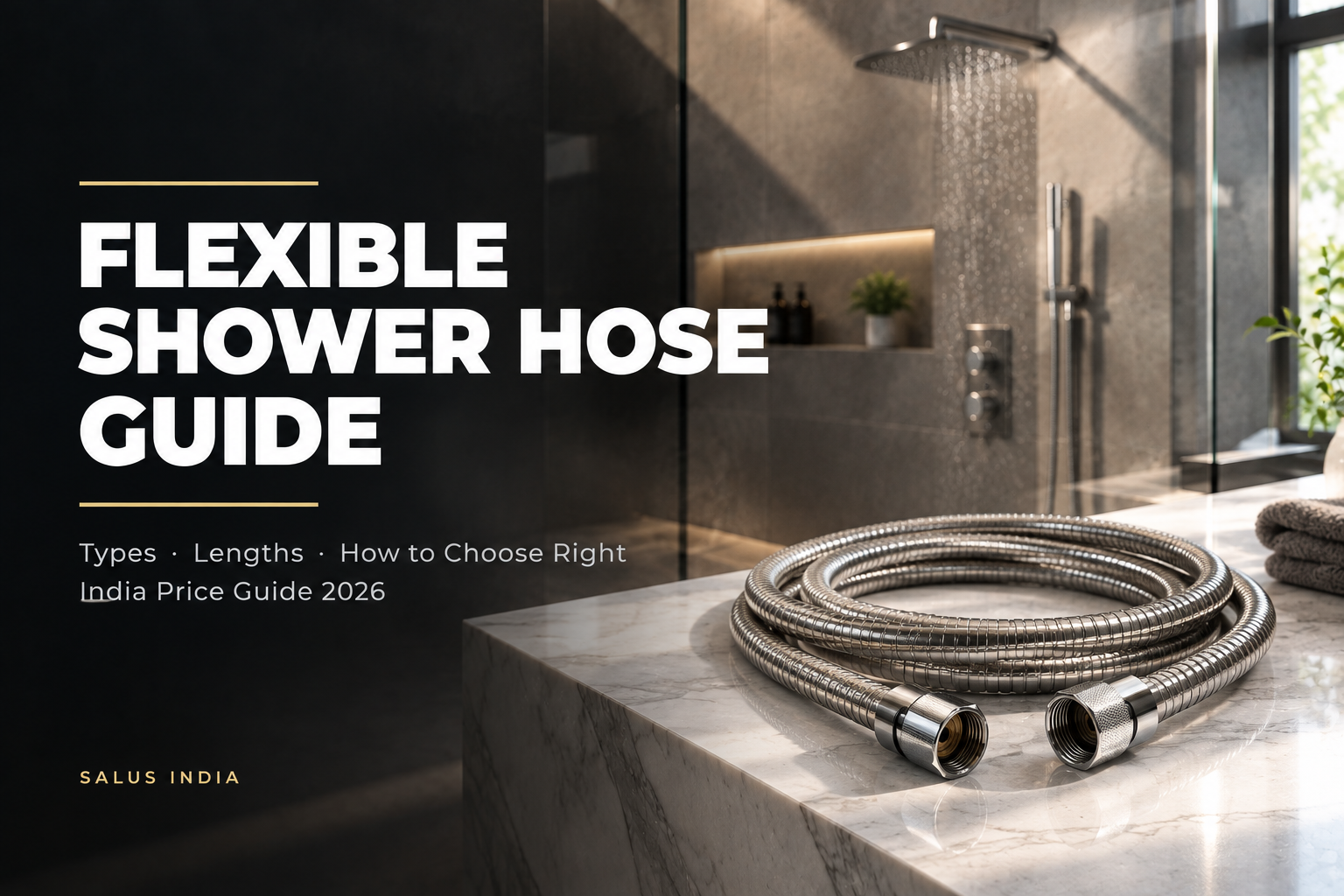
The flexible shower hose is the most frequently replaced fitting in any Indian bathroom, and the most commonly bought wrong. It connects the hand shower head to the wall outlet or slide rail, bends with every movement, and either kinks and leaks after a year or lasts a decade without a thought. The difference comes down to three things: the core material, the outer braid, and whether the thread ends match your existing fittings. This guide covers all three, plus how to pick the right length, how to care for it in Mumbai’s hard water, and what a reliable flexible shower hose costs in 2026.
What Is a Flexible Shower Hose?
A flexible shower hose is a reinforced tube that carries water from a fixed wall outlet or slide rail bracket to a handheld shower head. It bends and repositions with the hand shower’s movement while maintaining a sealed, pressure-rated connection at both ends.
Most flexible shower hoses in India connect using 1/2 inch BSP thread fittings at each end, the same standard found in hand showers, health faucets, and most Indian wall outlets. A standard hose has two nut fittings, one at each end, and a length of 1.5 metres suits most standard shower configurations. Browse our hand shower and shower accessories to see flexible hoses alongside matching shower heads and slide rails.
Why the Hose Is the Part That Fails First
A shower hose bends at the same points hundreds of times a week. The nut fittings at each end experience constant micro-movement as the hand shower swings and is placed back on its bracket. In Mumbai’s hard water, mineral deposits inside the hose gradually narrow the bore, reducing flow pressure before anything else visibly fails.
Cheap hoses fail at the crimp point where the nut meets the hose body. A quality hose uses a swivel nut at each end that rotates independently of the hose body, preventing the hose from twisting and fatigue-cracking at the neck. This is the single most useful feature to check before buying a replacement.
Hose Materials: Which One Lasts
| Material | Inner Core | Outer Layer | Life in Hard Water | Price |
|---|---|---|---|---|
| Stainless steel braided | EPDM rubber | SS wire braid | Best, 8-12 years | Highest |
| Chrome-plated brass braid | EPDM rubber | Brass wire, chrome-plated | Good, 5-8 years | Mid |
| PVC with SS braid | PVC | SS wire braid | Fair, 4-7 years | Low-mid |
| Plain PVC | PVC | None | Worst, 1-3 years | Lowest |
A stainless steel braided hose costs more upfront but resists kinking, handles the pressure cycles of a booster pump system, and does not degrade from scale the way plain PVC does. In hard water areas like Mumbai and Navi Mumbai, the inner rubber core on a cheap PVC hose absorbs mineral compounds over time and becomes brittle. Plain PVC hoses that last three years in soft water may fail in 18 months in Mumbai’s conditions.
Standard Lengths and Which to Choose
Flexible shower hoses come in three standard lengths:
- 1.0 metre: For compact shower cubicles or when the wall outlet is very close to the slide rail bracket. Keeps the hose from looping on the floor.
- 1.5 metres: The most common length for Indian bathrooms. Gives enough reach to use the hand shower at all heights on a slide rail and to rinse the full shower area without pulling taut.
- 1.8 to 2.0 metres: For large walk-in showers, wide rain shower areas, or when the outlet is far from the shower position. Also useful if the user frequently takes the shower head off the rail entirely.
Measure the distance from your wall outlet to the bottom of the slide rail, then add 30 to 40 cm for the hand shower’s natural swing range. Our bathroom hand shower page lists the slide rail height and recommended hose length for each model.
Connection Fittings and Thread Compatibility
Both ends of a flexible shower hose connect with a nut fitting, and both must match the thread size of what they connect to. In India, almost all hand showers and wall outlets use 1/2 inch BSP (British Standard Pipe) thread. If your existing fittings use a different standard, adapters are available but add a potential leak point.
Check that the nut fittings rotate freely on the hose before buying. A fixed nut that cannot swivel forces the hose to twist when you move the shower head, and that twisting causes fatigue cracking at the neck. All quality flexible shower hoses have swivel nuts at both ends.
Our bathroom tap fittings guide covers BSP thread standards for Indian plumbing in more detail, useful if you are replacing multiple fittings in one session and need to confirm compatibility across all connections.
Hard Water Care and Descaling
In Mumbai’s hard water, limescale builds inside the hose bore over time, narrowing the flow and eventually restricting the hand shower to a weak, uneven spray. Two habits prevent most of this:
- After each shower, run the hand shower pointing upward for a few seconds to drain standing water from the hose bore. Mineral deposits form faster in stagnant water than in flushed pipes.
- Every two to three months, soak the nut ends in mild white vinegar or a proprietary descaler for 20 to 30 minutes to dissolve deposits at the connection points where scale accumulates fastest.
For a full care routine that covers all shower fittings at once, this bathroom fittings maintenance guide walks through descaling intervals and annual checks in detail. A functioning hand shower with consistent pressure is one of those small daily comforts that adds up, the kind of detail this piece on how your bathroom can boost daily wellness explores in more depth.
Flexible Shower Hose Price Guide India 2026
| Type | Length | Price (INR) |
|---|---|---|
| Plain PVC | 1.5 m | ₹80 to ₹250 |
| PVC with SS braid | 1.5 m | ₹250 to ₹600 |
| Chrome-plated brass braid | 1.5 m | ₹500 to ₹1,200 |
| SS braided, swivel nuts | 1.5 m | ₹800 to ₹2,500 |
| Premium anti-kink SS braid | 1.5-2.0 m | ₹1,500 to ₹4,000 |
At the ₹800 to ₹2,500 range, you get a hose that will likely outlast three or four budget hoses and fit better alongside a quality hand shower. Premium anti-kink versions add a coil spring guard at each nut connection, protecting the neck where bending stress concentrates, and that single feature is worth the extra cost in a bathroom used multiple times a day.
Conclusion
A flexible shower hose is a small fitting with a short replacement cycle if you buy cheap and a long one if you buy right. Match the length to your shower layout, choose a stainless steel braided hose with swivel nuts over a plain PVC one, and descale the nut ends every two to three months in hard water areas. Every flexible shower hose in Salus India’s range has been selected with this durability standard in mind.
Frequently Asked Questions
Q1. What length flexible shower hose do I need for my bathroom?
Measure from the wall outlet to the bottom of the slide rail and add 30 to 40 cm for natural movement range. For most standard Indian bathrooms, a 1.5 metre hose covers the full slide rail range without excess length pooling on the floor. Use 1.8 metres or longer only for wide walk-in showers or if the user frequently takes the shower off the rail.
Q2. What is the difference between a braided and plain PVC shower hose?
A braided shower hose has a wire mesh over the rubber or PVC inner core. The braid prevents kinking, handles higher water pressure, resists bursting, and protects the inner core from chemical exposure. A plain PVC hose has no braid, kinks at stress points, and fails faster in hard water and high-pressure systems.
Q3. Why is my shower hose leaking at the connection?
Leaks at the nut end usually come from a worn rubber washer inside the nut, a damaged thread, or mineral scale preventing a clean seal. Unscrew the nut, check the washer, replace it if flat or cracked, and rewrap PTFE tape on the thread before reassembling. If the nut thread is stripped, replace the hose entirely.
Q4. Can I use any shower hose with any hand shower?
Almost all Indian hand showers use the standard 1/2 inch BSP thread, so compatibility is rarely an issue at the hand shower end. The wall outlet end may occasionally use a different diameter on older or imported fittings. Check both ends before buying, and carry the old nut to the showroom if unsure.
Q5. How often should a flexible shower hose be replaced?
A quality stainless steel braided hose with swivel nuts lasts 8 to 12 years in hard water. A chrome-plated brass braid hose lasts 5 to 8 years. Plain PVC hoses in Mumbai’s hard water need replacing every 1 to 3 years. Replace any hose showing visible cracking at the neck, persistent leaking, or reduced flow after descaling.
Q6. What thread size does an Indian shower hose use?
The Indian standard for shower hoses is 1/2 inch BSP, matching hand showers, wall outlets, slide rails, and most other bathroom fittings. If your existing outlet uses a non-standard thread, BSP adapters are available but add a potential leak point. Confirm the outlet thread size before buying a replacement hose.
Q7. How do I stop my shower hose from kinking?
Buy a hose with swivel nuts at both ends, which let the fittings rotate without twisting the hose body. If kinking happens mid-hose, upgrade to an anti-kink model with a coil spring guard at each neck. Never leave the hose looped tight on its bracket; hang it straight so the bore memory does not set into a bent shape.