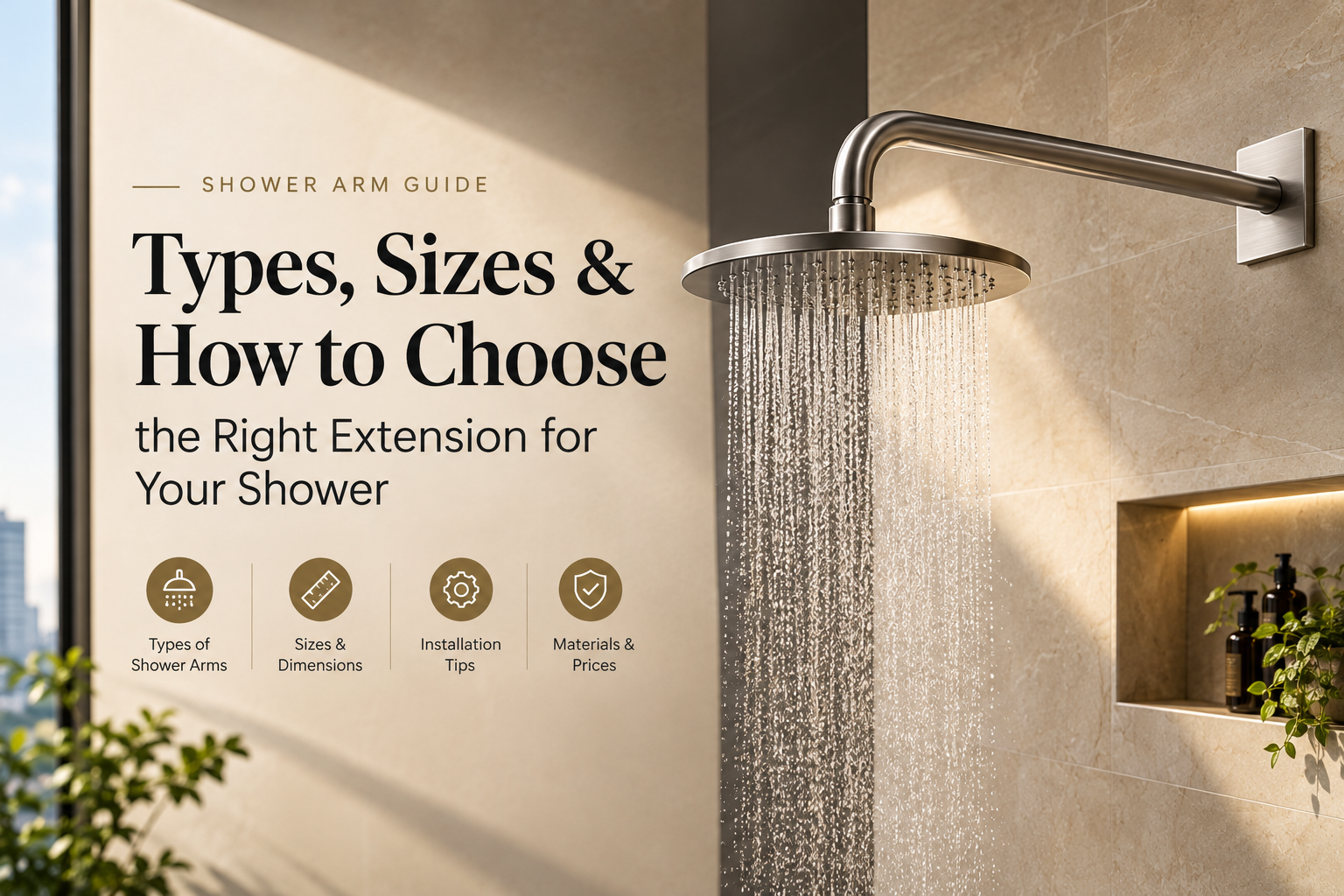
The shower arm is the one fitting in a bathroom shower system that almost every homeowner ignores when planning a renovation and regrets when it is too short, too thin, or the wrong angle. It is the pipe extension that carries water from the wall outlet to the overhead shower head, and the way it is shaped, angled, and sized determines whether your rain shower head sits directly above your shoulders or 20 cm behind your head. This guide covers every type of shower arm used in Indian bathrooms, how to choose the right length and angle, what thread sizes matter, and what a quality arm costs in 2026.
What Is a Shower Arm?
A shower arm is a rigid or adjustable pipe extension that connects a wall supply outlet to an overhead shower head. It threads into the wall outlet at one end and the shower head at the other. The arm’s job is to move the shower head from the wall surface to the position directly above the user, and to angle it so the spray falls vertically.
Most shower arms in India connect using 1/2 inch BSP thread at both ends. The wall-side connection threads into the supply elbow embedded in the wall; the head-side connection threads into the inlet nut of the overhead shower head. Browse our bath and shower accessories to see shower arms alongside matching overhead shower heads and concealed shower valves.
Types of Shower Arms
Standard Fixed Arm (S-Bend / Goose Neck)
The most common type in Indian bathrooms. A metal tube bent in an S or gentle goose-neck curve, extending from the wall outlet forward and downward to position the shower head over the user’s head. Lengths range from 250 mm to 400 mm. This type fits most standard Indian shower configurations where the wall supply outlet is at roughly shoulder to head height.
Ceiling-Mount Shower Arm
A straight vertical drop arm that connects to a supply outlet in the ceiling rather than the wall. The arm descends from the ceiling to the shower head position below, with a 90-degree elbow at the top connection. Used exclusively with ceiling-mounted supply plumbing planned before the ceiling is finished. Lengths from 150 mm to 400 mm below ceiling level.
Adjustable Angle Shower Arm
A ball-joint arm with a pivot point that allows the shower head angle to be adjusted after installation. Useful when the wall supply outlet is at an unusual height or angle relative to the shower area, letting the user point the head directly overhead without changing the plumbing.
Extension Shower Arm
A straight tube that extends the reach of an existing shower arm or adds length when the standard arm does not bring the head far enough over the user. Typically 150 mm to 300 mm long, threaded at both ends.
Slide Bar / Rail with Arm Combo
A slide bar system where the hand shower and the overhead shower head mount to the same rail, fed from the same supply point. Common in compact Indian bathrooms where a single supply point feeds both outlets through a diverter.
Shower Arm Comparison
| Type | Best For | Length | Mount |
| Standard S-bend / goose neck | Most Indian bathrooms | 250-400 mm | Wall |
| Ceiling-mount | New build with ceiling supply | 150-400 mm drop | Ceiling |
| Adjustable angle | Unusual outlet positions | 200-350 mm | Wall |
| Extension arm | Adding reach to existing arm | 150-300 mm | Wall |
| Slide bar combo | Compact bathrooms, dual outlet | Fixed by rail | Wall |
How to Choose the Right Length
The shower arm length determines where the shower head sits relative to the user. Get this wrong and the rain shower head hangs over the back of the user’s head or too close to the wall, requiring the user to stand at an awkward angle.
Measure the distance from the centre of your wall supply outlet to the point directly above where the primary user will stand. This is the arm reach you need. For a standard Indian bathroom with a wall outlet at roughly 2 metres height and the shower position about 300 to 400 mm from the wall, a standard S-bend arm of 300 to 350 mm provides enough reach to centre the head.
Confirm the arm length before buying by holding a tape measure from the outlet centre horizontally to the standing position. Add 50 mm for the shower head overhang. Check height: the shower head’s underside should sit at least 200 mm above the tallest user’s head for comfortable use without ducking.
Thread Sizes and Compatibility
In India, the standard thread on shower arm connections is 1/2 inch BSP at both ends. This matches the wall supply outlet thread and the inlet thread on most overhead shower heads. Confirm both connections before purchasing if your existing fittings are imported or non-standard.
The arm-to-wall connection uses a wall flange plate to cover the gap between the arm pipe and the tile surface. The flange slides over the arm before it is threaded in and sits flush against the tile, hiding the supply outlet hole. Match the flange finish to the shower arm finish and to other visible fittings in the shower area.
Materials and Finish
Shower arms in Indian bathrooms need to resist hard water scale on the outer surface and standard water pressure inside. Stainless steel bodies with chrome plating are the most practical: resistant to corrosion, easy to descale, and consistent in finish over years of use.
Brass bodies with chrome plating cost more but offer better corrosion resistance at the thread connections, where dissimilar metal corrosion can occur over time in hard water conditions. Black matte and brushed gold finishes are available for design-forward bathrooms but require more frequent wiping to maintain appearance. Match the arm finish to the shower head, the concealed valve trim, and any bathroom tap fittings visible in the same space.
Hard Water Maintenance
Limescale builds up on the outer surface of the shower arm at the connection points and at the flange plate, where standing water evaporates after each shower. Wipe the arm exterior monthly with a damp cloth and a mild descaler. Avoid abrasive cleaners that scratch the chrome finish and make the surface more susceptible to future scale bonding.
The inner bore rarely blocks on a standard fixed arm, but if shower head pressure drops after descaling the head itself, remove the arm and check the internal bore for scale buildup. This bathroom fittings maintenance guide covers descaling for all shower fittings as part of an annual routine. Getting this right is part of the broader case for a bathroom that works without friction, which this piece on daily bathroom wellness habits puts in a useful perspective.
Shower Arm Price Guide India 2026
| Type | Length | Price (INR) |
| Standard S-bend, ABS, chrome | 250-300 mm | ₹300 to ₹1,000 |
| Standard S-bend, SS, chrome | 300-400 mm | ₹800 to ₹2,500 |
| Standard S-bend, brass, chrome | 300-400 mm | ₹1,500 to ₹4,000 |
| Adjustable angle arm, SS | 200-350 mm | ₹1,500 to ₹5,000 |
| Ceiling-mount arm, brass | 150-400 mm | ₹2,000 to ₹6,000 |
| Long extension arm, brass | 400-600 mm | ₹2,500 to ₹8,000 |
Plumber cost to replace a shower arm: ₹500 to ₹1,500 depending on accessibility.
Conclusion
A shower arm is not a fitting to buy on price alone. The right length centres the shower head over the user; the right material survives Mumbai’s hard water without corroding at the thread connections; and the right finish holds its look alongside the rest of the shower hardware. Salus India’s shower arm range covers standard S-bend, adjustable, and extension types in SS and brass bodies for Indian installation requirements.
Frequently Asked Questions
Q1. What is a shower arm and what does it do?
A shower arm is a pipe extension that connects the wall supply outlet to the overhead shower head, moving the head from the wall surface to a position directly above the user. It threads into the wall outlet at one end and the shower head at the other. The arm’s length and angle determine whether the shower head is centred above the user’s shoulders or off to one side.
Q2. What length shower arm do I need?
Measure from the centre of your wall supply outlet to the point directly above where you will stand, then add 50 mm for the shower head overhang. For most standard Indian bathrooms with the outlet near shoulder height, a 300 to 350 mm arm positions the head correctly. Use an extension arm if the standard length still does not reach the standing position.
Q3. What thread size does a shower arm use in India?
Almost all Indian shower arms use 1/2 inch BSP thread at both the wall outlet connection and the shower head connection. This is the same standard as hand showers, concealed valves, and most other bathroom fittings in India. Confirm compatibility if your existing fittings are imported or non-standard.
Q4. Can I replace a shower arm without calling a plumber?
Yes, for a standard wall-mounted arm. Turn off the water supply at the shower valve or main stopcock, unscrew the old arm anticlockwise from the wall outlet, wrap the new arm’s thread with PTFE tape, and thread the new arm in clockwise. Reconnect the shower head. The job takes under 30 minutes with basic tools.
Q5. Why is my shower arm leaking at the wall connection?
Leaks at the wall connection come from a worn PTFE tape seal, a cracked or corroded thread, or mineral scale preventing a clean seal at the connection face. Unscrew the arm, clean the thread, apply fresh PTFE tape in two to three wraps, and reinstall. If the wall outlet thread is damaged, a plumber needs to replace the supply elbow behind the tile.
Q6. What is the difference between a fixed and adjustable shower arm?
A fixed arm has a set S-curve angle that does not change after installation. An adjustable arm has a ball-joint pivot that lets you change the shower head angle after installation, useful if the wall supply outlet is at an unusual height or angle. Adjustable arms cost more but solve positioning problems that a fixed arm cannot.
Q7. How much does a shower arm cost in India in 2026?
A solid stainless steel S-bend arm with chrome finish costs ₹800 to ₹2,500. Brass S-bend arms run ₹1,500 to ₹4,000. Adjustable angle arms cost ₹1,500 to ₹5,000. Ceiling-mount arms range ₹2,000 to ₹6,000. Installation is ₹500 to ₹1,500 for a straightforward arm swap.