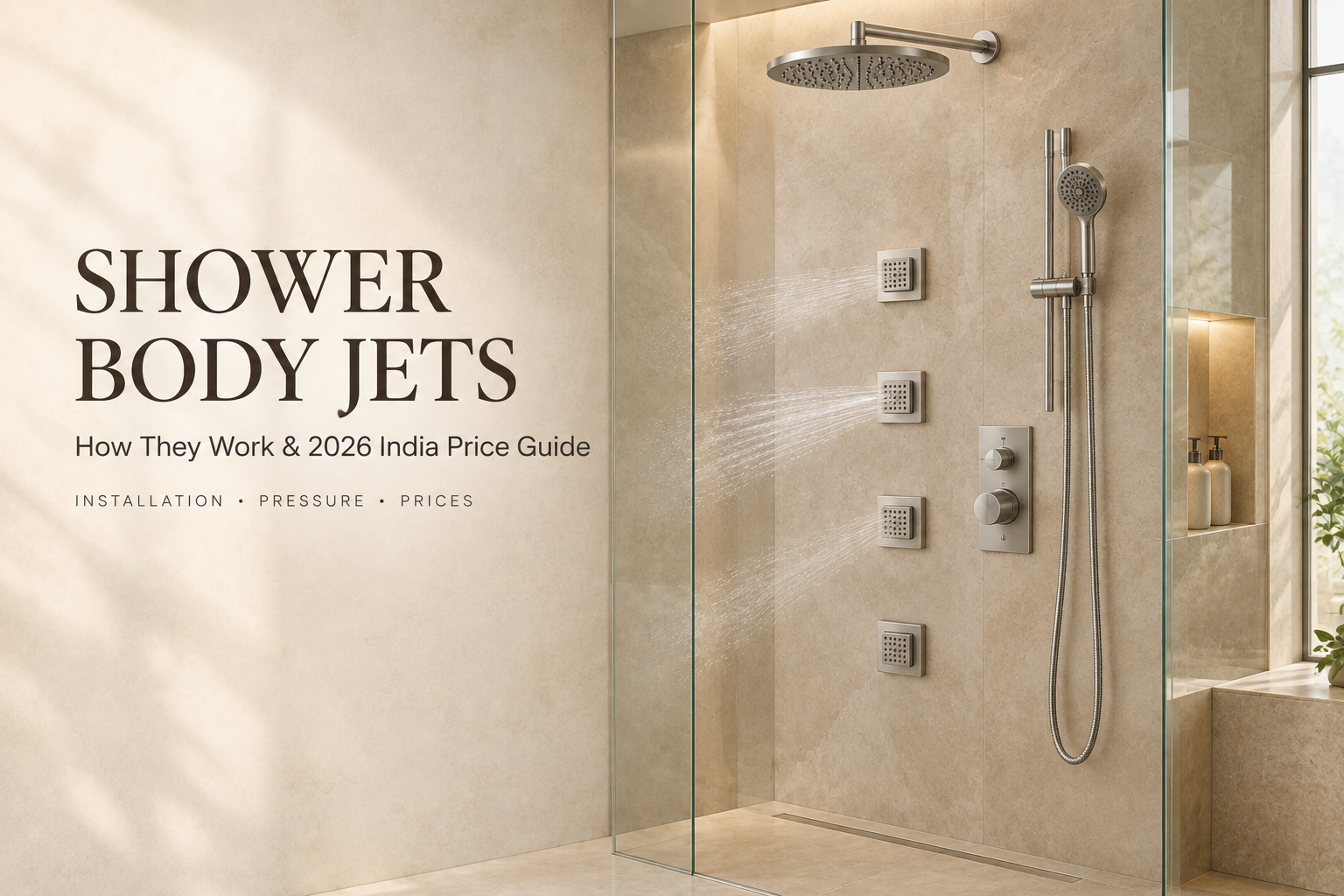
Shower body jets turn an ordinary bath into a full body water massage, spraying horizontally at chest, waist, and hip height while your overhead rain shower and hand shower handle the rest. Every premium Indian bathroom renovation project asks about them now, and every plumber has a story about a jet system that arrived with barely a trickle of pressure. That gap between the showroom demo and the actual output usually comes down to three things: how many jets you install, whether you choose concealed or exposed fittings, and whether your building’s water pressure can support the setup at all. This guide walks through how shower body jets work, the pressure math behind them, where to place them, which materials survive Mumbai’s hard water, and what a reliable system costs in 2026.
What Are Shower Body Jets
Shower body jets are wall mounted nozzles that spray water horizontally against your body, usually positioned at chest, waist, and hip height around one or more shower walls. Unlike an overhead rain shower that drops water straight down, a body jet pushes it sideways, so several jets firing together create a surrounding massage effect rather than a single stream.
Most premium systems pair three to six body jets with a diverter valve, letting you switch between the overhead rain shower, the handheld unit, and the jets independently, or run two together. Browse a full range of shower and bath accessories to see how body jets fit alongside rain showers and hand showers in one complete system.
The spray is not just for comfort. A well angled jet loosens tight shoulder and back muscles the way a low pressure massage would, and that daily reset matters more than it sounds. It is part of why how your bathroom can boost daily wellness argues for treating your shower as recovery time, not just a wash. Whether that actually happens depends entirely on the pressure math in the next section.
Concealed vs Exposed Body Jets
Two installation formats cover almost every body jet setup sold in India today, and picking the wrong one means paying twice.
| Feature | Concealed Body Jets | Exposed Body Jets |
| Installation stage | Rough-in body fitted inside the wall before tiling | Panel or jets mounted directly on the finished wall |
| Best suited for | New construction, full bathroom rebuilds | Renovations, retrofits without breaking walls |
| Visible finish | Only the jet face and control plate show | Full jet body and sometimes piping visible |
| Repair access | Requires opening tile work | Straightforward, no wall breakage |
| Typical price (3-4 jets, INR, 2026) | ₹40,000 to ₹90,000 | ₹15,000 to ₹60,000 |
Concealed jets look cleaner and suit the seamless wall finish most premium renovations chase, but the valve body has to go in before the tiler starts. Lock this decision into your bathroom renovation checklist at the plumbing stage, not after the walls are already tiled.
Exposed jets skip that constraint. A plumber taps into your existing supply lines and mounts the jet panel on the wall in an afternoon, which is why most retrofit projects in older Mumbai apartments go this route.
How Many Jets Your Water Supply Can Handle
Here is the part most homeowners skip, and it is the reason so many body jet installations disappoint. Each jet needs roughly 3 to 5 litres per minute (LPM) at 2 to 3 bar pressure to deliver an actual massage spray rather than a dribble.
Add up a realistic bathroom:
- 4 body jets at 4 LPM each: 16 LPM
- 1 overhead rain shower: 8 to 10 LPM
- 1 hand shower running alongside: 6 to 8 LPM
Run all three together and you need 30 to 34 LPM flowing through the line at once. A typical Indian overhead tank gravity feed delivers only 0.3 to 0.5 bar, nowhere near enough to hit that number, which is exactly why so many jet systems get installed and then complained about within a week.
The fix is not fewer jets, it is supply. A booster pump rated for 1 to 1.5 bar output resolves the shortfall for most three to four jet setups, and it costs far less than ripping out an underperforming system later.
Placement Guide: Getting Height and Spacing Right
Jet placement follows the body, not a fixed formula, but three bands work for most adult heights:
- Chest height jets: 48 to 52 inches from the finished floor
- Waist height jets: 38 to 42 inches from the finished floor
- Hip and lower back jets: 28 to 32 inches from the finished floor
Space jets 8 to 10 inches apart horizontally if you are running a row across one wall, and angle each nozzle slightly downward and inward so the sprays overlap rather than fire past each other. A plumber adjusting angles during a dry test, before the wall is sealed, saves you from discovering a badly aimed jet six months later.
Brass vs ABS: Which Nozzle Material Lasts
Body jet nozzles come in two materials, and the price difference tells you why. Brass bodies with a chrome or PVD finish resist corrosion and hold their spray pattern for a decade or more, even under Mumbai’s hard water. ABS plastic nozzles cost less upfront, sometimes half the price, but the material scales up faster and the spray holes distort within three to five years.
Pair a brass jet system with a matching bathroom hand shower in the same finish, since mixing plastic and brass fittings in one shower area tends to age unevenly and look mismatched within a year or two. On a four jet set, brass over ABS usually adds ₹8,000 to ₹15,000, money that buys another five to seven years of service life.
Keeping Body Jets Clog-Free in Hard Water
Mumbai and Navi Mumbai’s hard water is unkind to anything with a small opening, and body jet nozzles have some of the smallest openings in your bathroom, often under 2mm wide. Calcium and magnesium deposits build up inside that opening fast, and a jet that sprayed evenly on installation day can turn into an uneven dribble within four to six months if nobody touches it.
Soak exposed jet heads in a mild descaling solution once a month, and schedule a professional descaling of concealed valve bodies every six months, since you cannot reach those nozzles yourself without removing tile work. Following a consistent bathroom fittings maintenance routine protects the pressure math you worked out earlier, because a clogged nozzle behaves exactly like an undersized water supply.
Shower Body Jet Price Guide in India (2026)
| Category | Price range (INR) | What you get |
| Entry-level exposed, 2-3 jets | ₹15,000 to ₹30,000 | ABS or basic brass nozzles, chrome finish |
| Mid-range exposed, 4 jets + diverter | ₹30,000 to ₹60,000 | Brass body, adjustable spray, better finish options |
| Concealed system, 3-4 jets | ₹40,000 to ₹90,000 | In-wall valve body, brass jets, diverter control |
| Premium imported, 6+ jets, thermostatic control | ₹90,000 to ₹2,50,000+ | Precision cartridges, PVD finishes, full digital control |
Add ₹8,000 to ₹25,000 for a booster pump if your building’s pressure falls short, and factor in installation labour of ₹5,000 to ₹15,000 depending on concealed or exposed work.
Frequently Asked Questions
Q1. What are shower body jets?
Shower body jets are wall mounted nozzles that spray water horizontally against your chest, waist, and hip, creating a surrounding massage effect. They work alongside an overhead rain shower and a hand shower rather than replacing either. Most systems use three to six jets connected through a single diverter valve, letting you switch between fittings or run several at once.
Q2. How many body jets should I install?
Match jet count to your actual water supply, not to how many the showroom displays. Each jet needs about 3 to 5 LPM at 2 to 3 bar pressure, so four jets alone need 16 to 20 LPM. Most Indian homes without a booster pump comfortably support two to three jets; anything more usually needs a pump upgrade first.
Q3. Why do my shower body jets have no pressure?
Low pressure almost always traces back to one of three causes: too many jets drawing from a line that cannot supply enough LPM, a gravity-fed tank delivering under 0.5 bar, or scale buildup inside the nozzle openings from hard water. Check nozzle clogging first since it is the cheapest fix, then test the actual line pressure before assuming you need a pump.
Q4. Should I choose concealed or exposed body jets?
Concealed jets suit new construction or full bathroom rebuilds since the valve body must go inside the wall before tiling, giving a cleaner finished look. Exposed jets suit renovations where you do not want to break existing walls, and a plumber can fit them in an afternoon. Budget and construction stage usually decide the choice, not preference alone.
Q5. Does normal Indian bathroom pressure support body jets?
Rarely, on its own. Most Indian buildings rely on gravity-fed overhead tanks delivering 0.3 to 0.5 bar, well below the 2 to 3 bar a body jet needs to spray properly. A booster pump rated 1 to 1.5 bar, typically costing ₹8,000 to ₹25,000 installed, closes that gap for most three to four jet setups.
Q6. How much do shower body jets cost in India in 2026?
Entry-level exposed sets with two to three jets start around ₹15,000, while mid-range four-jet exposed systems run ₹30,000 to ₹60,000. Concealed systems cost ₹40,000 to ₹90,000, and premium imported ranges with thermostatic control can cross ₹2,50,000. Add a booster pump and installation labour on top if your building’s pressure falls short.
Q7. How often should body jets be descaled in hard water areas?
In Mumbai and Navi Mumbai’s hard water, descale exposed jet heads about once a month using a mild descaling solution soak. Concealed systems need professional descaling roughly every six months since the nozzles sit behind tile work. Skipping this lets calcium deposits narrow the spray openings within four to six months.
A Full Body Shower Starts With the Right Pressure Plan
Shower body jets deliver a genuine spa level upgrade, but only when the jet count matches what your building’s water supply can actually push through. Get the pressure math right, choose concealed or exposed based on your construction stage, and pick brass over ABS if Mumbai’s hard water runs through your pipes. Explore concealed and exposed body jet systems at Salus India, where 50 years of curated imported fittings back every recommendation.